How to Choose a Titanium Exhaust in 2026?
Choosing a Titanium Exhaust in 2026 starts with a useful question: what do you need it to do? Lower weight, sharper throttle response, or a particular sound? The right choice depends on the vehicle, riding or driving conditions, and your tolerance for cost and upkeep. Titanium is not an automatic upgrade.
ASM International’s materials data place commercially pure titanium at about 4.51 g/cm³, compared with roughly 7.8 g/cm³ for common stainless steels. That difference can make a system noticeably lighter. But weight alone does not guarantee better performance. Tube diameter, wall thickness, weld quality, mounting points, and silencer design all matter. A poorly matched system can sound harsh or fit badly. Small details count.
The USGS Mineral Commodity Summaries 2025 tracks titanium supply and production, useful context for understanding material availability and price pressure. It does not evaluate exhaust brands or predict real-world gains. For technical perspective, Matthew J. Donachie, author of Titanium: A Technical Guide, offers a practical principle—paraphrased here, not a verbatim quotation: “Judge titanium by its alloy and processing, not by its name alone.” That is worth remembering when a product page gives big promises but few specifications. Ask for the alloy, construction details, fitment information, and any testing data. Then compare them with your actual needs. And listen in person, if possible. A bright showroom blip can become tiring on a long ride. My own caution: lighter is compelling, but not always better.
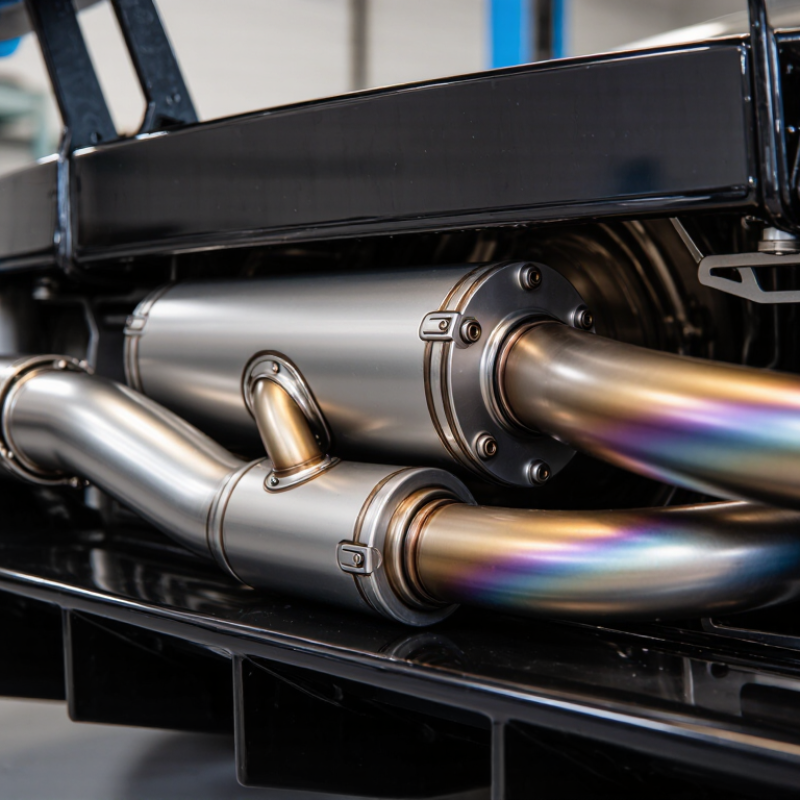
Define Your Vehicle, Driving Goals, and Budget
How to Choose a Titanium Exhaust in 2026? Define Your Vehicle, Driving Goals, and Budget
Start with the exact vehicle: model year, engine, body style, and existing exhaust layout. A system built for a similar-looking car may still need different hangers or pipe diameters. Check the manufacturer’s fitment details, then ask a qualified exhaust shop to confirm clearance around the underbody and nearby components. Fit matters. ASM Handbook data puts titanium’s density near 4.5 g/cm³, compared with about 7.85 g/cm³ for carbon steel. That sounds compelling, but material density alone cannot predict the finished system’s weight; pipe thickness, design, and hardware matter too.
Define the driving goal before setting a budget. For a street-driven car, prioritize sensible sound levels, durable joints, and dependable fit. For track use, compare measured system weight and heat management, not just a headline weight-saving claim. SEMA’s 2023 Market Report estimated U.S. specialty-equipment sales at $52.3 billion in 2022. That figure describes a broad market, not titanium-exhaust prices, so use written, vehicle-specific quotes instead. Include installation, replacement gaskets, and any needed adjustments in your budget. No guesswork. I would also question whether a small weight reduction justifies a large premium on a daily driver. It may not. A shop inspection and a clear comparison of total installed cost can expose that trade-off before purchase.
How to Choose a Titanium Exhaust in 2026? Define Your Vehicle, Driving Goals, and Budget
Material density helps explain titanium’s weight-saving potential. These approximate room-temperature values are for the raw materials; actual exhaust-system weight depends on design, tubing thickness, and vehicle fitment. Confirm compatibility and compare complete-system prices before buying.
Approximate material densities: titanium 4.51 g/cm³; 304 stainless steel 8.00 g/cm³; 316 stainless steel 8.00 g/cm³; carbon steel 7.85 g/cm³.
Compare Titanium Grades, Wall Thickness, and Construction
Choosing a titanium exhaust starts with the material grade, not the color of the tubing. Grade 2 is commonly used for exhaust pipes because it balances strength, formability, and weldability. Grade 1 is more formable but generally softer. Grade 5 offers higher strength, though shaping and welding it can require more care. Ask for a material specification or certificate; appearance alone cannot confirm the grade.
Wall thickness affects weight and durability. Very thin tubing saves grams, but may dent more easily from road debris or handling. Thicker walls add weight and can resist damage better. There is no perfect number for every car. Consider how the vehicle is driven and where the pipes sit.
Tips: Compare stated wall thickness, not just pipe diameter. Check welds for even beads and clean joints. Look for sound mounting points and flexible sections that accommodate movement. A tidy weld is reassuring, but it does not prove the whole system is well made. Construction details matter: poor fitment can place stress on joints, while careful bends help maintain clearance. Be cautious of vague “titanium” claims; exact grade and thickness should be documented.
How to Choose a Titanium Exhaust in 2026? Compare Titanium Grades, Wall Thickness, and Construction
Use this comparison to match material and construction to your vehicle, intended use, and budget. Specifications vary by system design; confirm the exact alloy and measured wall thickness with the fabricator.
| Comparison Point |
Grade 1 |
Grade 2 |
Grade 9 |
Grade 5 |
| Material type |
Commercially pure titanium with relatively low strength and high ductility. |
Commercially pure titanium; a common balance of strength, formability, and corrosion resistance. |
Ti-3Al-2.5V titanium alloy; stronger than commercially pure grades while retaining useful tubing formability. |
Ti-6Al-4V titanium alloy; high strength, but generally less straightforward to form and more expensive than common exhaust-tubing choices. |
| Typical exhaust suitability |
Best considered for specialized designs where easy forming and lower strength are acceptable. |
A practical choice for many road and performance exhaust systems. |
A strong candidate for thin-wall tubing where added strength is desired; verify availability and fabrication capability. |
Usually selected only when its higher strength is specifically needed; often unnecessary for a typical exhaust system. |
| Forming and fabrication |
Very formable, though its lower strength may require careful design to limit dents or distortion. |
Generally formable and weldable with suitable titanium procedures and contamination control. |
More demanding to form than commercially pure titanium; confirm bend quality and fabrication experience. |
More challenging and costly to fabricate into exhaust tubing; suitability depends on the design and qualified process. |
| Common wall-thickness range to compare |
About 0.8–1.2 mm (0.031–0.047 in) is a useful comparison range for many lightweight performance systems. Thicker tubing may be appropriate for durability, support, or rough use; thinner tubing needs careful protection from impact and vibration. |
| Weight and durability considerations |
Low density helps reduce system mass, but the design may need more support where loads or impacts are expected. |
Low mass with a useful balance of strength and corrosion resistance for many applications. |
Higher strength can help a designer use thin tubing, but durability still depends on layout, supports, welds, and use. |
High strength does not automatically make an exhaust lighter or longer-lasting; design and fabrication remain decisive. |
| What to verify before buying |
Confirm the alloy certificate, actual tube thickness, and suitability for the intended bends and mounting loads. |
Ask for the grade specification, thickness, weld process, and details of the mounting and flex sections. |
Verify that the tubing is genuinely Grade 9 and that the fabricator can form and weld it consistently. |
Confirm why Grade 5 is specified, how tubing is formed, and whether the added cost provides a real design benefit. |
| Construction Feature |
What to Look For |
Why It Matters |
| Tube and bend quality |
Smooth bends with no obvious wrinkles, flattening, cracks, or abrupt changes in diameter. |
Good geometry helps maintain flow area and reduces weak points or unwanted restrictions. |
| Weld quality |
Consistent, fully fused welds made with appropriate inert-gas shielding; ask how the inside of the joint is protected during welding. |
Titanium can react with oxygen at welding temperatures. Poor shielding may contaminate and weaken the weld area. |
| Wall thickness consistency |
Ask whether the stated thickness is nominal or measured, and check for unusually thin sections around bends and joints. |
Local thinning can affect impact resistance, fatigue life, and the reliability of the system. |
| Mounting and vibration control |
Secure hangers, adequate clearance, and suitable flex sections or joints where the system design requires them. |
Good support reduces stress on thin tubing and welds as the vehicle moves and the exhaust heats and cools. |
| Fitment and serviceability |
Check vehicle-specific fitment, sensor bungs, connection style, heat clearance, and access to removable sections. |
Correct fitment helps prevent leaks, contact with nearby components, and unnecessary installation stress. |
Verify Fitment, Included Components, and Installation Requirements
A titanium exhaust can reduce weight and sharpen response, but fitment comes before material claims. In 2026, check the exact vehicle year, engine, body style, and existing exhaust layout. Compare inlet diameter, pipe routing, and mounting points with your current system. A few millimeters can affect alignment. Small details matter. Confirm whether the setup is designed for your vehicle configuration, rather than relying on a broad model description.
Read the included-components list carefully. It may cover pipes and clamps but exclude gaskets, hangers, or hardware needed for installation. Check whether the exhaust connects to the factory system or requires additional parts. Review the installation guide before ordering, and note any required tools, lifting equipment, or sensor transfers. If the instructions are unclear, ask a qualified installer to assess the vehicle. I would not assume every kit is a direct fit; listings can leave gaps.
Tips: Photograph your current connections and mounting points before removal. Compare those images with the product diagram. Do not guess. Allow the exhaust to cool fully, support the vehicle securely, and follow the manufacturer’s torque specifications. After installation, check for leaks, contact with nearby components, and rattles during a short, careful inspection.
Review Warranty, Product Quality, and Total Ownership Cost
When choosing a titanium exhaust in 2026, read the warranty before comparing prices. Check its term, mileage limit, corrosion coverage, and exclusions for modified parts or demanding use. Find out whether labor, gaskets, clamps, and shipping are covered. A long warranty may still leave you paying for removal and refitting. Keep the invoice and installation records; they can matter when making a claim. Small detail, but important.
Product quality needs more than a polished weld. Inspect tube thickness, weld consistency, hanger placement, and clearance around the bumper and suspension. ASM International’s Titanium: A Technical Guide puts titanium’s density at about 4.5 g/cm³, compared with roughly 8.0 g/cm³ for common austenitic stainless steel. That difference can reduce system weight, but it does not prove better durability or performance. Ask for material specifications and check how the manufacturer addresses heat cycling, vibration, and condensation inside the muffler. That number is not the whole story.
Calculate total ownership cost, not just the checkout price. Include installation, replacement hardware, repairs, and any future labor if a section fails. A close-fitting system may save adjustment time; a poor fit can add hours. I would still question optimistic weight claims without a stated measurement method. Compare the quoted weight with your original system, and keep some budget for small parts that are easy to overlook.
 +86 17870576410